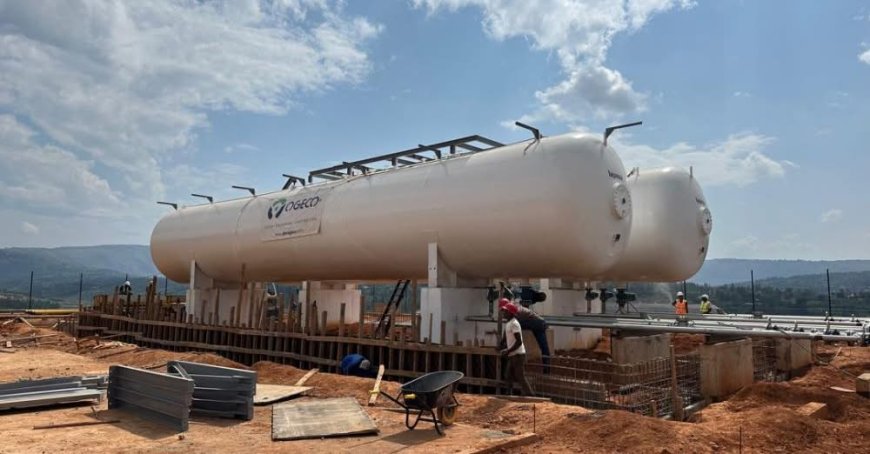
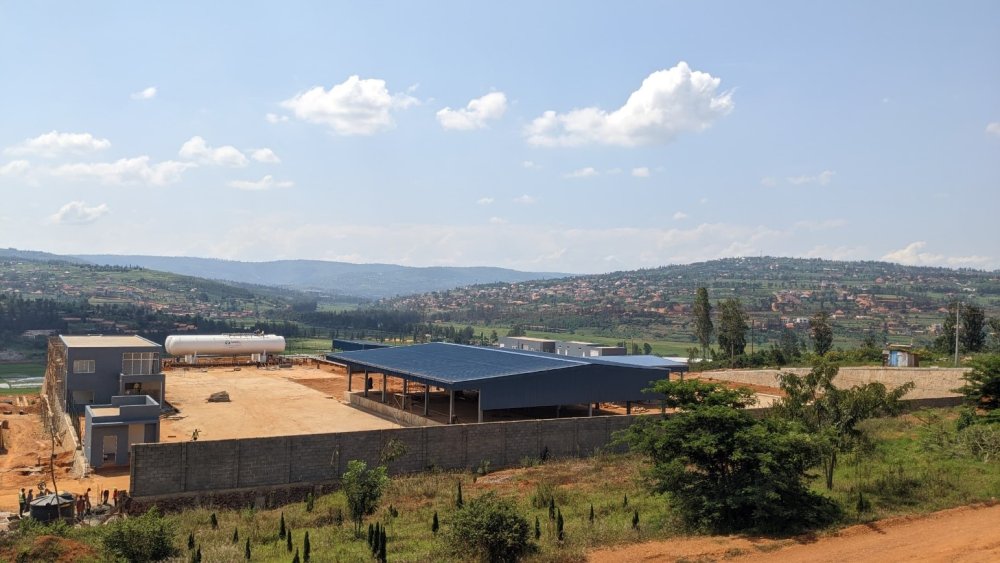
A liquefied petroleum gas (LPG) storage depot worth $44 million (over Rwf60 billion) being set up in Rusororo Sector, Gasabo District
Construction of five large cooking gas storage facilities in Rwanda has reached 70% completion, marking a significant milestone in the country’s energy transformation plan.
The facilities, with a combined capacity of 17,500 cubic meters, are being built on six hectares in Rusororo, Gasabo District at an estimated cost of Rwf65 billion. They are expected to start supplying gas by July 2026.
The project supports Rwanda’s national goal of reducing reliance on wood-based fuels, improving public health, and strengthening resilience to climate change.
Abdul Rahman, the project’s construction manager, told RBA that the new storage facilities will allow large quantities of gas to be preserved efficiently and provide benefits to consumers.
“The gas will be transported in trucks carrying 20 to 25 tons, stored in these large tanks, and then distributed to daily-use facilities and cylinders for customers,” Rahman explained.
He added that the tanks will also allow other gas distributors in Rwanda to source supplies locally, helping to lower prices.
“With a storage capacity of 17,500 cubic meters, the country will have two main advantages; a secure national supply during emergencies or global market disruptions, and the ability to reduce prices through bulk storage and distribution,” he said.
Rahman further noted, “Currently, we import 200–300 tons at a time. With the new tanks, we can bring in 1,000 to 4,000 tons, creating room for better negotiations with suppliers. This will reduce costs for industries and eventually for consumers.”
Local gas distributors have welcomed the project, highlighting its benefits for both businesses and customers.
Jean Damour Ntibutura said, “Previously, we faced high transport costs and limited supply, which raised prices. Once these tanks are operational, new investors may also build smaller local tanks, improving supply and stabilizing costs.”
Dr. Joseph Akumuntu, Chairperson of the Rwanda Petroleum Importers and Distributors Association (ASSIMPER), described the storage facilities as a solution to fluctuating gas prices.
“The tanks will provide transparency and stability, ensuring everyone knows supply levels and reducing price discrepancies,” he said.
Plans are also underway to make gas more affordable by allowing citizens to purchase smaller quantities according to their budgets.
The facilities, with a combined capacity of 17,500 cubic meters, are being built on six hectares in Rusororo, Gasabo District.