
















The assassination everyone expected: Why Habyarimana’s death was no surprise

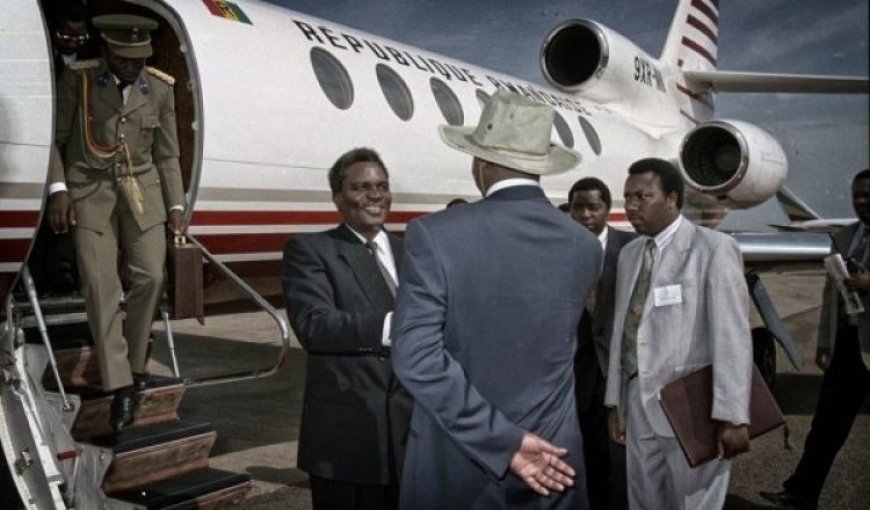
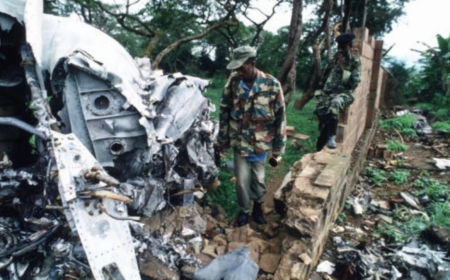
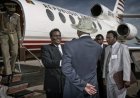
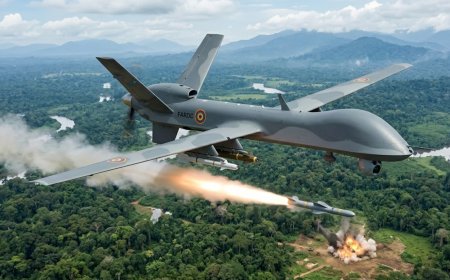
The assassination of former Rwandan president Juvénal Habyarimana on April 6, 1994—when his Falcon 50 jet was shot down on its approach to Kigali—has often been portrayed as a sudden rupture. It was not.
The political climate, intelligence warnings, and openly murderous rhetoric that preceded that night point to a more troubling conclusion: Habyarimana’s death was not an unforeseeable shock, but the culmination of a trajectory many in power had long anticipated. Habyarimana, who had ruled Rwanda since 1973, was returning from a regional summit in Dar es Salaam when surface-to-air missiles struck his plane. While credible investigations have pointed to Hutu extremists within his own circle as possible orchestrators, the broader context is equally revealing.
In elite political, military, and diplomatic circles, the possibility of his assassination was neither remote nor unthinkable. It was increasingly expected. At the center of that expectation was fierce opposition to the Arusha Accords. Negotiated between the Rwandan government and the Rwanda Patriotic Front (RPF), the accords were intended to establish a power-sharing arrangement and end the civil war.
For hardline Hutu extremists, often grouped under the banner of “Hutu Power,” compromise was treated as betrayal. Any concession to RPF was cast not as statesmanship, but as surrender.
Figures such as Théoneste Bagosora made that hostility unmistakable. Bagosora, one of the regime’s most notorious hardliners, denounced the Arusha process and spoke ominously of preparing an “apocalypse” upon his return to Rwanda.
Within that ideological framework, Habyarimana’s removal became logical once he was seen as wavering—or worse, capitulating. He was no longer simply president; he was an obstacle.
And the expectation of his death was not confined to private conversations behind closed doors. It was signaled in public.
Extremist publications and broadcasters repeatedly foreshadowed the president’s assassination.
The newspaper Kangura, under Hassan Ngeze, explicitly predicted in December 1993 that Habyarimana would die in March 1994. It even suggested that the assassin would be a Hutu whose act would later be framed to serve anti-Tutsi propaganda. This was not mere commentary—it was political conditioning.
A similar pattern emerged on RTLM, the notorious radio station that played a central role in mobilizing Hutu civilians against the Tutsi. On April 3, 1994, broadcaster Noël Hitimana warned of an imminent “small unexpected event”—akantu—that would trigger a fatal attack in Kigali within days. He preemptively blamed the RPF and forecast a violent reaction from the Rwandan Armed Forces (FAR). This was not speculation; it was narrative preparation. It suggested not only foreknowledge of a catalytic event, but readiness to exploit it immediately.
Testimony from insiders reinforces this picture. Valérie Bemeriki, who was linked to extremist media circles and related to Bagosora, later stated that as early as March 1994 she had been informed through MRND networks that the president might be assassinated.
Information of that nature does not circulate casually; it spreads because a network is bracing for action.
Warnings also came from beyond Rwanda. Foreign leaders and intelligence services were aware that Habyarimana faced a credible threat.
Former Zairean president Mobutu Sese Seko reportedly urged Habyarimana not to attend the Dar es Salaam summit, citing intelligence—partly sourced from the French—that an attack was being planned. He is said to have warned that the president could be targeted upon his return.
Burundian authorities issued similar cautions, warning their own president, Cyprien Ntaryamira, against traveling with Habyarimana because of the risk. Belgian military personnel stationed in Rwanda also had intelligence pointing to an imminent “extraordinary event,” possibly a coup or the assassination of the head of state.
Even within Habyarimana’s inner circle, the danger was understood. His legal adviser, Johann Scheers, later testified that the president feared leaving Rwanda could cost him his life.
Earlier in 1994, Habyarimana canceled a planned trip to Côte d’Ivoire due to security concerns. These were not the instincts of a man unaware of the threat, but of a leader navigating an increasingly perilous political landscape.
Within the FAR, discussion of a possible assassination was widespread, particularly among officers linked to extremist networks.
Members of the presidential guard—and even the Falcon 50 crew—were aware of intelligence suggesting the aircraft itself could be targeted. Reports of visible anxiety among the crew underscore how credible those warnings had become.
Then came the aftermath—and it is here that the claim of surprise collapses entirely.
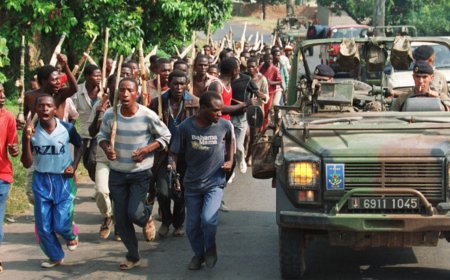
Within hours of the crash, roadblocks were erected across Kigali. Prime Minister Agathe Uwilingiyimana and other moderate Hutu leaders were hunted down and killed.
The genocide against the Tutsi, alongside the elimination of political opponents, began with terrifying speed.
The machinery did not need time to organize; it was already in place. Kill lists existed. Militias were prepared. Orders spread rapidly because the system had already been primed.
State-aligned media immediately blamed the RPF and framed mass violence as “self-defense.”
That response was too swift, too coordinated, and too ideologically coherent to have been improvised.
Whatever uncertainty remains about who fired the missiles, far less uncertainty surrounds what followed: extremists were ready to weaponize the assassination the moment it occurred.
That is the central point. From predictions in Kangura and coded warnings on RTLM to intelligence shared among military, diplomatic, and political actors, the evidence suggests that Habyarimana’s death was not treated as a distant possibility.
It was treated as an approaching event.
The signs were not subtle. They were abundant.
For many within Rwanda’s ruling circles—and for more than a few foreign observers—the president’s death was not a question of if, but when. In the final weeks before April 6, tensions between Habyarimana and the powerful Akazu network linked to his wife, Agathe Kanziga, had intensified.
Hardliners within that circle increasingly viewed even reluctant movement toward implementing Arusha as intolerable. In that environment, assassination ceased to be an unthinkable breach—it became a political instrument.
When the Falcon 50 carrying Habyarimana was brought down, it did not trigger an unforeseen crisis. It ignited a catastrophe that had been anticipated, discussed, and meticulously prepared for.