





























‘Killed twice’: A Bigogwe survivor’s story of loss and resilience

In the scenic mountainous region of Bigogwe, in present-day Nyabihu District, the persecution of the Tutsi began long before 1994.
It was here that violence was rehearsed: soldiers from the Bigogwe military camp staged fabricated attacks to justify the systematic targeting and killing of Tutsi civilians.
For Sifora Nyiragapapuro, 81, a resident of Bigogwe Sector and a survivor of the 1994 Genocide against the Tutsi, those years of fear are not distant history—they are memories she carries every day. Today, she still lives in the same home where she endured unimaginable suffering, a place that holds both the weight of loss and the quiet strength of survival.

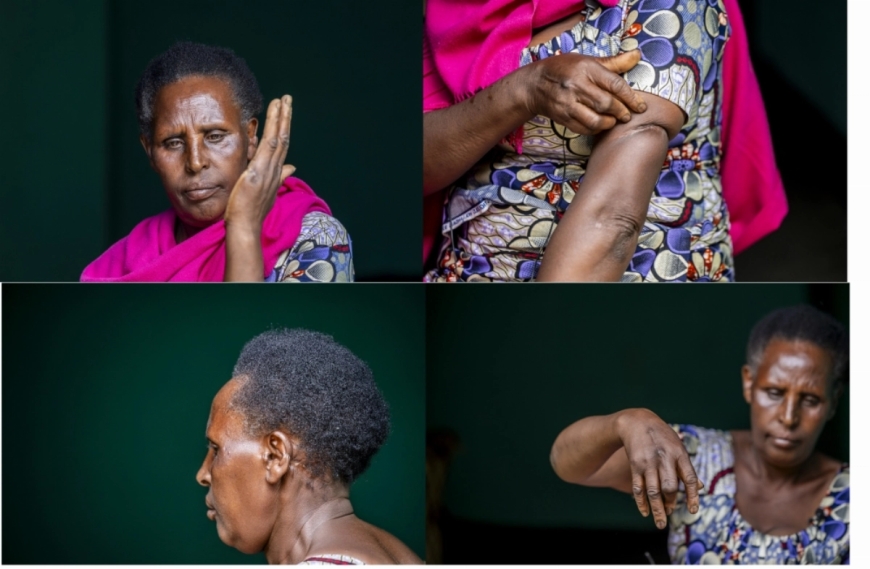
Sifora Nyiragapapuro, 81, a survivor of the 1994 Genocide against the Tutsi during the interview in Bigogwe Sector. Photos by Olivier Mugwiza
Early persecution; 1990–1993
Nyiragapapuro’s story did not begin in April 1994. Like many Tutsi in Bigogwe, persecution started as early as 1990, when Tutsi residents were accused of supporting “Inyenzi”—cockroaches, the derogatory term used by Hutu extremists to dehumanize them.
“Whenever we went to the market, they would beat us and destroy whatever we had bought. Fear and suspicion became part of our daily lives,” she recalls.
By 1992, the attacks had intensified. People were beaten, some were killed, and others were taken to Gisenyi.
“That year, my husband was brutally attacked. They cut him and threw him into a pit, leaving him for dead. When he was eventually pulled out, he was still breathing. He survived, but the injuries never healed. In 2015, those same injuries took his life.”
In 1993, the sound of gunfire near her home forced her and other residents to flee into the forest in search of safety. Even when authorities instructed Tutsi to separate from Hutu neighbours, the violence did not stop.
“In the end, many Tutsi were still killed. The promise of protection was a cruel illusion.”

Nyiragapapuro endured unimaginable suffering.
Nyiragapapuro and several other parents later sought refuge near the commune offices. “There were about five of us. When we arrived, they said, ‘You see, your fellow Inyenzi are attacking us, and now you are coming here to hide.’ Then they beat us. The next day, they told us to go back home,” she recalls.
In 1994, life became unbearable. After the death of President Habyarimana, former military officer Col. Ephrem Setako ordered everyone to stay indoors. Setako, who had been the director of legal affairs in the army before and during the genocide, hailed from Ruhengeri and was a close family friend of Habyarimana.
Found guilty of genocide, crimes against humanity (extermination) and serious violations of Article 3 common to the Geneva Conventions and Additional Protocol II (murder), in February 2010, he was sentenced to 25 years for Genocide by the now defunct International Criminal Tribunal for Rwanda (ICTR).
The international court found that Setako, among others, ordered the killings of 30 to 40 Tutsi civilians at Mukamira military camp in Ruhengeri, Northern Province on April 25, 1994 and around 10 other Tutsi on May 11, 1994. Through his various contacts, Setako organized the supply of machetes and arms to Interahamwe gangs spread out in the country. He also commanded and encouraged soldiers to eliminate all Tutsi targets.
“Houses were set on fire. Tutsi men, women, and children were killed with machetes. The hunt for families was relentless,” Nyiragapapuro recalls.
“My family and I had no choice but to flee into the forest. The suffering we endured there was unimaginable. We stayed hidden for about a week while they hunted us.”

Genocide survivor Sifora Nyiragapapuro, shows The New Times reporter scars on her body.
The Interahamwe eventually found them. Seeing that they had fled with their cattle, the perpetrators separated the livestock and slaughtered it before leaving, Nyiragapapuro remembers. At the time, she was pregnant and already had eight children. After a few days in hiding, the killers returned searching for them again.
“To survive, we ran with many other families. We scattered in all directions. Some of my children were killed, and I was separated from my eight-year-old daughter while my husband fled with some of our children in another direction.”
Severely injured, she continued moving with the surviving children, crawling and struggling to escape.
“Along the way, I was fortunate to find people who helped me reach Rubavu. But when we arrived, we were attacked again and cut with machetes. I felt like I was ‘killed’ twice.”
She later gave birth in the same area where many had been killed, but sadly, her baby and the child she had been carrying on her back did not survive. “I had eight children before the genocide. Today, I have only three left,” she says.
Escape and recovery
“I was all alone, but I kept crawling. Somehow, I managed to cross the border, and herders found me. They took me to Goma, in eastern DR Congo,” she recalls.

Some of the scars on her head, near her left ear, were inflicted when she was cut with a machete.
There, she received treatment for her injuries and stayed for three months. Around August, the news of peace returning back home reached them, and they returned to Rwanda, where RPF-Inkotanyi welcomed and comforted them.
“When I came back, the nightmares wouldn’t stop. I could barely sleep. People tried to comfort us, but the memories were always there. Today, we live like everyone else and are trying to rebuild our lives.”
Nyiragapapuro still bears physical scars from the genocide. She is deaf in one ear, one arm does not function, and she often suffers headaches caused by machete wounds. She continues to receive medical care.
A message to young Rwandans

Nyiragapapuro left one of her fingers during the Genocide against the Tutsi. During the interview she emphasizes that the country’s future depends on its young people.
Nyiragapapuro emphasizes that the country’s future depends on its young people.
“Today, people can move freely without fear. Back then, seeing a machete meant death. Life has returned, but we must never forget what happened,” she says.
Her message to the younger generation is clear: “Love your country. Work for it, develop it, and reject genocide denial. Division destroys; it does not build.”

Some of the scars on her left arm were inflicted when she was cut with a machete.

Nyiragapapuro left one of her fingers during the Genocide against the Tutsi.

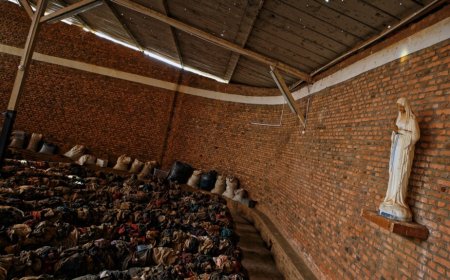
Bigogwe Genocide Memorial site. For many Tutsi in Bigogwe, persecution started as early as 1990, when Tutsi residents were accused of supporting “Inyenzi”—cockroaches. Courtesy