





The 2028 question: Will Tshisekedi step down?
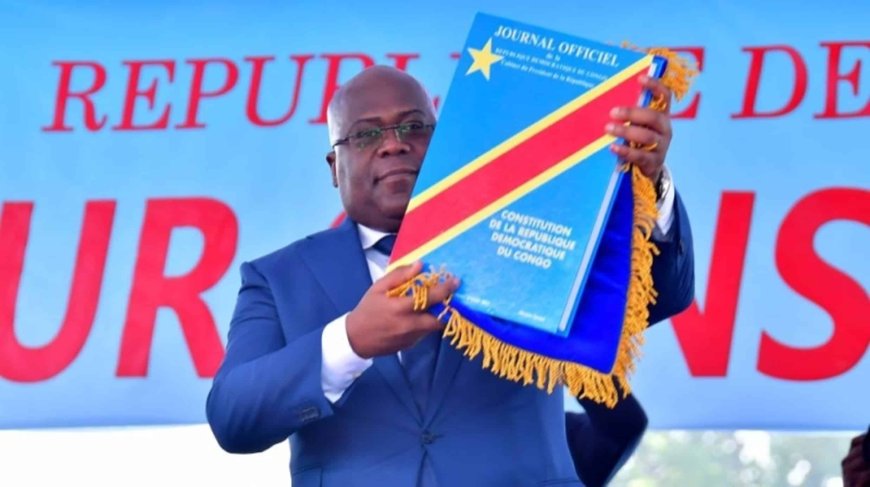
Political debate in the Democratic Republic of Congo (DRC) over President Félix Tshisekedi’s future beyond 2028 is no longer confined to private discussions within the ruling camp. It is now unfolding in full public view, raising fresh questions about whether the country’s constitutional order could be reshaped to extend his stay in power.
The 2006 Constitution is explicit: a president may serve no more than two terms. Yet senior figures within the ruling coalition are increasingly voicing support for constitutional reform, fueling suspicions that the real objective is not institutional improvement, but the removal or weakening of presidential term limits before Tshisekedi’s second mandate expires.
For months, the idea of revising the Constitution has circulated within the Union pour la Démocratie et le Progrès Social (UDPS) and allied political groupings. Supporters argue that Tshisekedi’s presidency has been severely constrained by the persistent security crisis in eastern Congo, particularly the conflict involving the M23 rebellion and the broader violence of armed groups. In their view, the ongoing war has prevented the president from fully delivering on his development agenda—circumstances they say justify a constitutional overhaul.
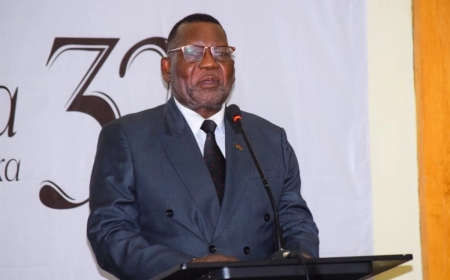
Over the weekend of March 7–8, 2026, those discussions appeared to move closer to an official political position. Christophe Mboso N’Kodia, Second Vice-President of the National Assembly and leader of the Convention pour la République et la Démocratie (CRD), publicly endorsed the idea of constitutional change.
“I am in favor of changing the Constitution. The 2028 elections will take place with a new Constitution,” Mboso said.
The statement was striking not only for its substance, but also because of who made it. Mboso holds a senior role in an institution tasked with upholding the constitutional order. His remarks suggest that influential actors within the political establishment may already be preparing public opinion for a major revision of the country’s fundamental law ahead of the next presidential election.
The push for constitutional change did not begin this year. It can be traced back at least to November 2024, when President Tshisekedi himself questioned the legitimacy of the 2006 Constitution, arguing that it had been “written by foreigners.” That comment immediately alarmed opposition figures and political observers, many of whom saw it as an opening move in a broader campaign to alter the rules governing presidential power.
Momentum behind the debate slowed temporarily earlier this year as the security situation in eastern Congo deteriorated sharply. The fall of the strategic city of Goma to M23 rebels, coupled with a worsening humanitarian crisis, shifted national attention toward war and state fragility. But the constitutional debate never disappeared—it merely receded into the background.
Its return now appears deliberate.
Mboso reinforced that impression by arguing that no law is immutable. “Only the Bible remains unchangeable,” he said, presenting constitutional revision as both normal and inevitable.
That argument, however, has done little to ease concerns. Supporters within the presidential majority insist that reform could address issues such as decentralization, institutional balance, and national stability. Critics counter that such justifications are largely rhetorical, masking a more consequential political aim: clearing the way for Tshisekedi to remain in power beyond the two-term constitutional limit.
Other government allies have also begun testing the idea more openly in public. Speaking at a rally in Kasangulu, in Kongo Central Province, Sports and Leisure Minister Didier Budimbu—who also heads the political grouping Autre Vision du Congo (AVC)—openly raised the prospect of a third term for Tshisekedi.
Addressing supporters in Lingala, Budimbu questioned the very premise of succession:
“If President Félix Tshisekedi must leave power, to give it to whom—and for what purpose?”
His message was clear. The issue is no longer whether constitutional reform is being discussed, but whether the ruling coalition can normalize the idea that Tshisekedi’s continued rule would be both legitimate and desirable. Budimbu argued that such a move would reflect not personal ambition, but the will of the Congolese people.
That claim is likely to be strongly contested. In the DRC, as elsewhere on the continent, appeals to “the will of the people” have often been used to justify constitutional engineering aimed at prolonging incumbency. For opposition leaders and civil society groups, this makes the current debate especially troubling. They see it as a direct challenge to one of the most important democratic safeguards established after years of war and authoritarian rule.
The issue is particularly sensitive in Congo because past attempts by leaders to extend their hold on power have repeatedly triggered political crises, violent repression, and mass protest. Against that backdrop, even the suggestion of tampering with presidential term limits carries the risk of deepening tensions in an already fragile state.
As the 2028 election cycle approaches, the debate is likely to intensify. What is at stake is not only Tshisekedi’s political future, but also the credibility of the constitutional framework governing democratic succession in the DRC.
Bahati Lukwebo controversy exposes divisions within the ruling coalition
The constitutional debate has also exposed unease within the Sacred Union, the broad ruling coalition backing President Tshisekedi.
Modeste Bahati Lukwebo, Second Vice-President of the Senate, found himself at the center of controversy after appearing to push back against the case for constitutional revision, before later issuing a public apology.
At the height of the debate, Bahati Lukwebo argued that the Constitution itself was not the country’s central problem:
“Le pays n’a pas de problème de textes. C’est plutôt un problème d’hommes.”
(The country does not have a problem with its laws; it has a problem with people.)
His point was unmistakable: the crisis lies less in the legal framework than in the conduct of those entrusted with applying it. In other words, Congo’s problem is not the Constitution, but the political class.
The remark was widely interpreted as a rebuttal to the growing push for constitutional reform. In Kinshasa’s charged political climate, it was seen as a veiled rejection of efforts to reopen the debate over presidential term limits and Tshisekedi’s future after 2028.
The backlash was swift.
Several members of the presidential majority reportedly viewed Bahati Lukwebo’s comments as out of step with the emerging line within the ruling camp. His statement appeared to contradict those advocating constitutional revision and, by extension, risked undermining allies of the president working to build support for change.
Faced with mounting criticism, Bahati Lukwebo later issued a public apology. He said he regretted the misunderstanding caused by his remarks and reaffirmed his loyalty to President Tshisekedi. The apology was clearly intended to contain the fallout and ease tensions within the coalition.
Even so, the episode was revealing. It showed that, despite the increasingly vocal push for constitutional reform, the issue remains deeply sensitive even among those formally aligned with the president.
It also underscored a central reality of the current debate: behind the public language of institutional reform lies a growing political struggle over power, succession, and the future of constitutional rule in the DRC.