




























Israel says it’s killed Iran’s security chief Larijani and Basij commander

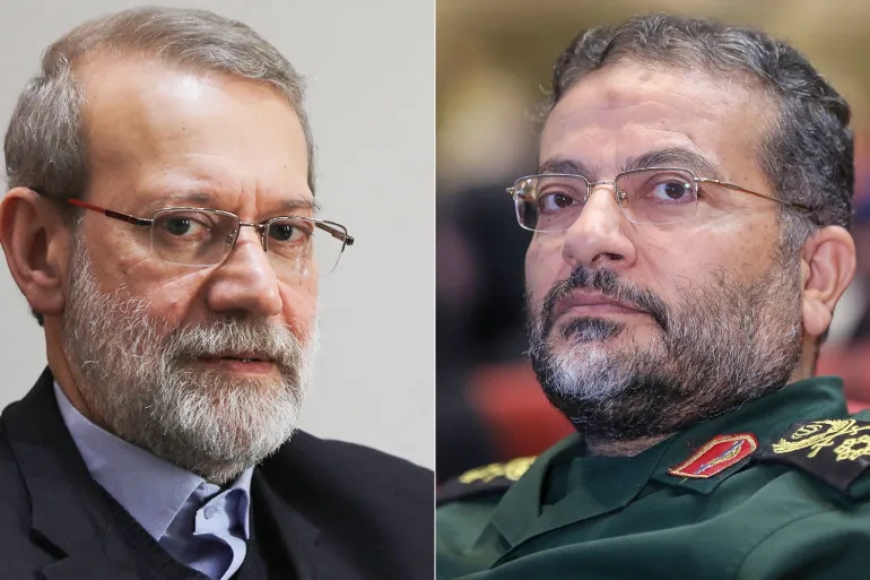
Israel has claimed to have killed Ali Larijani, secretary of Iran’s Supreme National Security Council, and the commander of the internal Basij militia, Gholamreza Soleimani, with no confirmation or denial by Iran so far.
Israel’s Defence Minister Israel Katz made the claim of Larijani’s death on Tuesday.
Meanwhile, Iranian state media published a handwritten note by Larijani, though it was not clear whether it was intended as proof of the life of the senior official. Larijani’s note, published on his social media pages, commemorates 84 Iranian sailors, whose funeral is expected on Tuesday, killed in a US attack on their naval ship in international waters.
If confirmed, Larijani would be the highest-level killing in the war since United States-Israeli strikes killed former Supreme Leader Ayatollah Ali Khamenei, and several members of his family, on the first day of the war they launched on February 28.
Larijani was last seen publicly on Friday, attending the Al-Quds Day rally in support of Palestinians in Tehran, along with President Masoud Pezeshkian.
He has been a key political figure in the Iranian hierarchy for years, at one time leading the nation’s nuclear negotiations with the West. Previously, he was also the Iranian speaker of the parliament.
Apparently referring to the high-profile killing, Katz said, “The leaders of the regime are being killed and their capabilities terminated.”
“Our army is working with strength to continue to hit and terminate the missile capabilities as well as the strategic infrastructure,” he wrote on social media.
In a message Monday, Larijani told Muslim-majority nations of Tehran’s position and reasserting that his country is not going to relent in the fight against the US and Israel. Larijani appealed to a religious sense of duty for Muslims to stand together, saying with few exceptions Islamic countries have failed to support Iran against what he called “treacherous aggression”.
“Is the stance of certain Islamic governments not at odds with the Prophet [Mohammad]’s saying: ’Whoever hears a man calling out, ‘O Muslims!’ and fails to answer him is not a Muslim?’”
He went on to justify Iran’s attacks across the region, which countries in the Gulf have described as blatant aggression against their sovereignty, appearing to warn there is no middle ground in the ongoing confrontations.
“Which side are you on?” Larijani asked. He followed his thinly veiled warning by emphasising Iran is not seeking domination over its neighbours.
“The unity of the Islamic nation, if realised with full strength, is capable of guaranteeing security, progress and independence for all its states,” Larijani added.
Al Jazeera’s Nida Ibrahim, reporting from the occupied West Bank, said the claimed killings would be celebrated in Israel as a big strategic success.
“But even if Larijani has been assassinated, that does not mean the whole regime has fallen,” Ibrahim said.
Al Jazeera’s Tohid Asadi, reporting from Tehran, said US-Israeli attacks were not limited to the capital, Tehran, but were reported in cities across the country, including Ahvaz, Isfahan and Shiraz.
Israeli Prime Minister Benjamin Netanyahu said the alleged killing of Larijani was part of an effort to give Iranian a way to overthrow the government.
“This morning we eliminated Ali Larijani, the boss of the Revolutionary Guards, which is the gang of gangsters that actually runs Iran,” Netanyahu said in a televised statement.
He added that overthrowing clerical authorities “will not happen all at once, it will not happen easily. But if we persist in this — we will give them a chance to take their fate into their own hands.”
Israel claims killing of Basij commander
The Israeli military also claimed in a post on X on Tuesday that it had killed Gholamreza Soleimani, the commander of Basij, the internal security paramilitary militia of the Islamic Revolutionary Guard Corps (IRGC).
“Guided by precise intelligence from Military Intelligence, the Air Force conducted a targeted strike yesterday in the heart of Tehran, eliminating Gholam Reza Soleimani, commander of the Basij unit over the past six years,” it said.
Iran has not confirmed this claim either.
Mohamad Elmasry, professor at the Doha Institute for Graduate Studies, said the US and Israel were playing a “game of whack-a-mole” in Iran.
“There’s always another leader … so I don’t think this is going to suggest any kind of collapse of the Iranian regime,” he said.
“Having said that, this is very significant symbolically [and] psychologically.”
The United States Treasury records Soleimani’s birth year as 1965. He has been sanctioned by the US, the European Union and other countries for his alleged role in suppressing dissent through the Basij, a volunteer paramilitary force under the IRGC, founded after the 1979 revolution and tasked with enforcing internal security nationwide.
It operates local branches across cities and is frequently deployed on the front lines of protests to crack down, including the antigovernment demonstrations that erupted across Iran in January, in which thousands were reportedly killed, and stretching back to the 2009 mass protests against what opponents called a stolen presidential election.
The Basij and other internal security forces have been frequent targets of attack by the US and Israeli forces so far in the war.